THE CHALLENGE
Modern buildings operate at the intersection of rising operational costs, complex stakeholder demands, and increasing expectations for energy efficiency and user experience, yet most current solutions fall short of delivering a viable business model for true autonomy. Centralized building management systems often function as opaque control centers that limit visibility into decision making, restrict stakeholder participation, and prevent buildings from dynamically allocating resources or optimizing costs in real time. Financial operations, space utilization, and physical automation are typically managed through disconnected platforms, creating inefficiencies that undermine return on investment and long-term sustainability. While technologies such as IoT sensors, AI driven control, and digital twins promise smarter operations, they are frequently deployed in siloed, cloud dependent architectures that raise concerns around resilience, data ownership, and scalability. As a result, building owners and operators struggle to transition from cost centers dependent on external funding into self-sustaining assets capable of autonomously balancing energy consumption, occupant comfort, and financial performance in a transparent and adaptive manner.
OUR SOLUTION
Buildings can be transformed from cost intensive assets into self-governing, revenue aware systems through a unified platform that combines decentralized governance, automated financial flows, and intelligent automation. By using blockchain based DAO smart contracts, stakeholders gain transparent and shared control over operational and financial decisions while automated space reservations and payments generate continuous income directly into a building treasury, enabling long term financial self-sufficiency. A locally hosted AI assistant powered by a large language model allows users to interact with building services in natural language, reducing operational overhead and improving user engagement without relying on complex dashboards. Real time sensor data and a digital twin provide continuous visibility into space usage and environmental conditions, while AI driven automation adjusts energy and comfort settings based on collectively defined rules to reduce waste and operating costs. Together, this approach delivers a scalable business model that lowers management complexity, improves trust and participation, and turns buildings into transparent, adaptive, and economically sustainable enterprises.
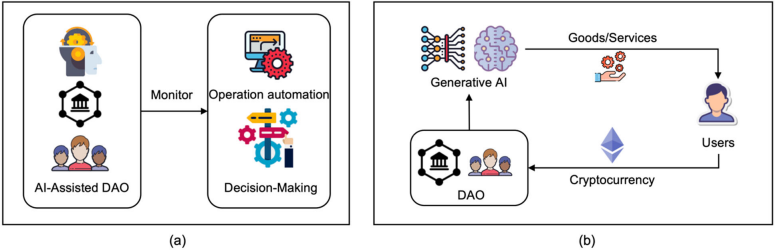
Figure 1: Integration of DAO and AI. (a) AI-assisted decentralized governance of operation automation (b) DAO-AI revenue model through AI-generated products and services.
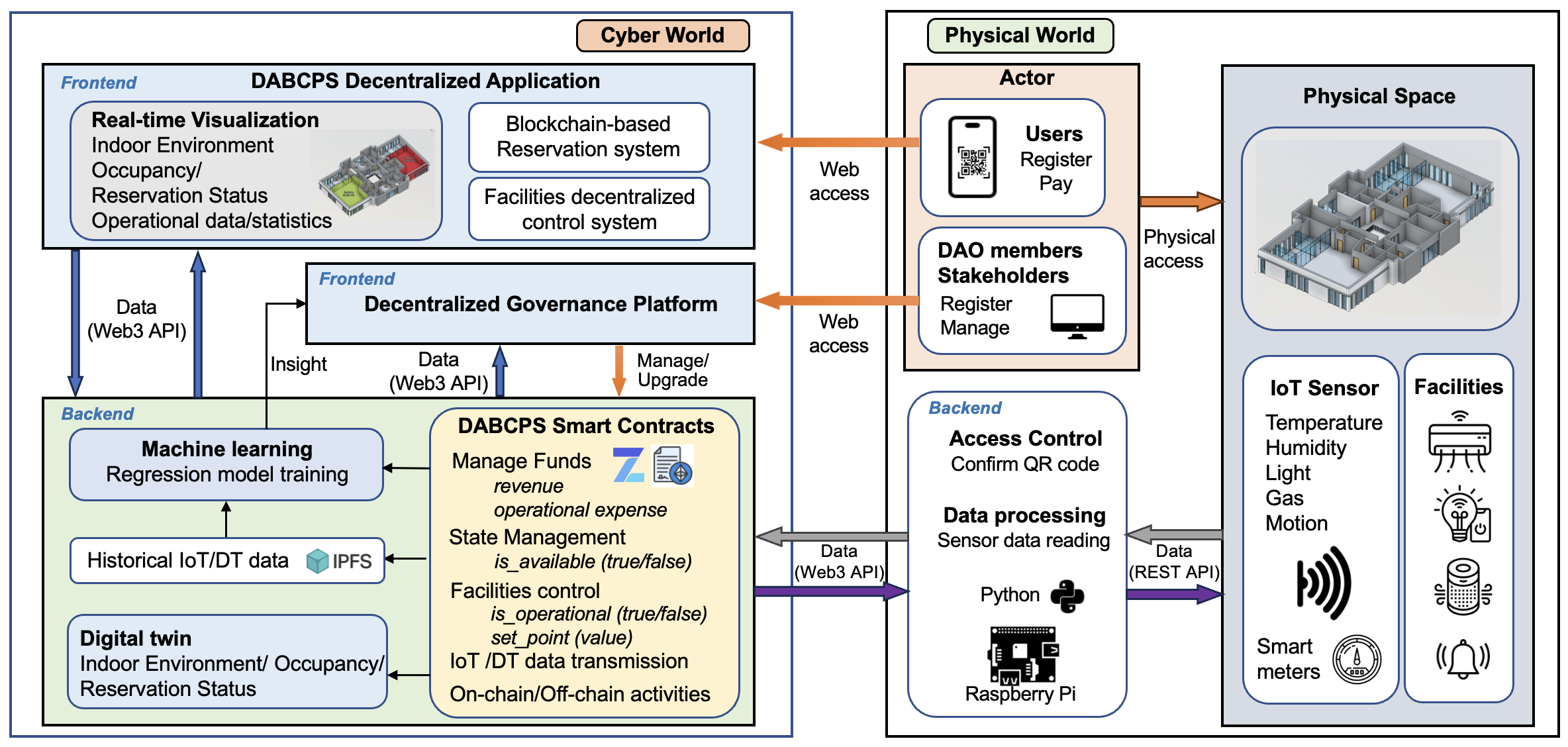
Figure 2: Proposed Decentralized Autonomous Building Cyber-Physical System (Orange arrow: Human interaction on the CPS, Grey arrow: Data from Physical to Cyber system, purple arrow: Response from Cyber to Physical system).
Advantages:
- Transparent and shared governance across all building stakeholders
- Autonomous revenue generation and financial self-sustainability
- Reduced operational costs through AI driven energy and space optimization
- Improved user experience via intuitive natural language interaction
Potential Application:
- Smart commercial and office building management
- University and institutional campus operations
- Co working and shared space automation
- Residential and mixed use building self-management