THE CHALLENGE
Developing reliable, energy‑efficient neuromorphic computing hardware offers a significant business opportunity, yet it faces critical technical hurdles. Filamentary resistive memory devices, widely considered for artificial synapses in AI and in‑memory computing, often struggle to deliver precise, stable analog resistance states due to destructive binary RESET operations. This leads to inconsistent weight updates, poor retention of high‑resistance states, and susceptibility to thermal crosstalk in dense arrays—factors that compromise device reliability and learning accuracy. For companies aiming to commercialize high‑density, low‑power AI hardware for edge computing, robotics, or autonomous systems, these limitations translate into production scaling challenges, reliability risks, and difficulty meeting the performance demands of modern AI workloads. Solutions that offer stable, continuous, and symmetric control of resistance states—while remaining compatible with existing fabrication processes—could unlock significant market value and accelerate the adoption of neuromorphic and analog in‑memory computing technologies.
OUR SOLUTION
Our technology enables a transformative approach to next‑generation memory and AI hardware by delivering precise, analog control over resistance states in filamentary ReRAM devices—significantly improving reliability and energy efficiency for commercial applications. By carefully controlling the RESET operation, the method stabilizes weak conductive filaments instead of destroying them, allowing fine‑tuned, predictable resistance changes essential for neuromorphic computing and artificial synapses. This innovation enhances retention, reduces variability, and ensures consistent performance even in dense memory arrays where thermal interactions often cause failures. Fully compatible with existing ReRAM stacks and requiring no additional fabrication complexity, the technology can be readily adopted by manufacturers seeking high‑density, low‑power, biologically inspired AI hardware. The result is a solution that boosts device reliability, lowers production risks, and accelerates the commercialization of advanced computing systems for markets such as edge AI, robotics, and autonomous electronics.
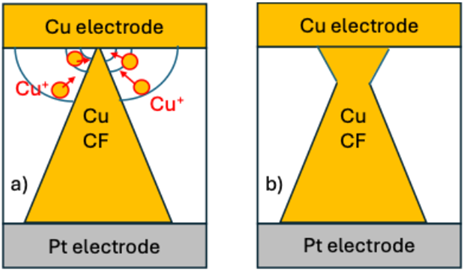
Figure: Reconstruction of the Cu conductive filament from (a) to (b). Filament re-formation controlled by the level of the compliance current, voltage ramp rate, and stop voltage—reduces the filament resistance when the initial resistance is sufficiently high. Resistance represents the synaptic weight.
Advantages:
- Precise and stable analog resistance control for reliable synaptic weight updates
- Non-destructive RESET enabling symmetric and linear weight modulation
- High-resistance state stabilization for improved memory retention and device reliability
- Compatible with existing ReRAM architectures, supporting scalable AI hardware
Potential Application:
- Neuromorphic computing hardware
- Edge AI and real-time accelerators
- Low-power IoT and embedded memory
- Analog neural network training