THE CHALLENGE
The key challenge lies in translating advanced neuromodulation technologies into solutions that are both clinically precise and commercially scalable. Noninvasive approaches like Transcranial Magnetic Stimulation lack the spatial resolution needed to effectively reach deep brain regions, while invasive methods such as Deep Brain Stimulation involve high procedural risks and costs that limit widespread adoption. Although Low Intensity Focused Ultrasound offers a promising balance with millimeter scale precision, existing systems depend on complex phased array transducers, high channel count electronics, and computationally intensive beamforming, making them bulky and expensive. In addition, variability in skull thickness and density introduces acoustic aberrations that reduce targeting accuracy and require patient specific corrections, further increasing system complexity and operational overhead. Together, these technical and economic barriers restrict portability, affordability, and scalability, slowing broader clinical adoption and limiting the market potential of precise noninvasive brain stimulation therapies.
OUR SOLUTION
Our approach centers on the BRAINWAVE system, a noninvasive neuromodulation platform designed to deliver precise brain stimulation while significantly lowering cost and complexity. Instead of relying on traditional phased array hardware, it uses precomputed acoustic holography with custom designed lenses that shape ultrasound waves to reach targeted brain regions with high accuracy. These lenses are generated using machine learning models trained on patient imaging data such as CT or MRI, enabling rapid and personalized treatment planning. The lenses are embedded in a skull conformal silicone interface that improves energy coupling and compensates for anatomical variability, reducing distortion caused by the skull. This design removes the need for expensive multi-channel electronics and heavy real time computation, making the system more compact and portable. By combining scalable manufacturing with automated personalization, the platform enables a cost effective, high precision neuromodulation solution that can expand access beyond specialized clinics and support broader clinical and commercial adoption.
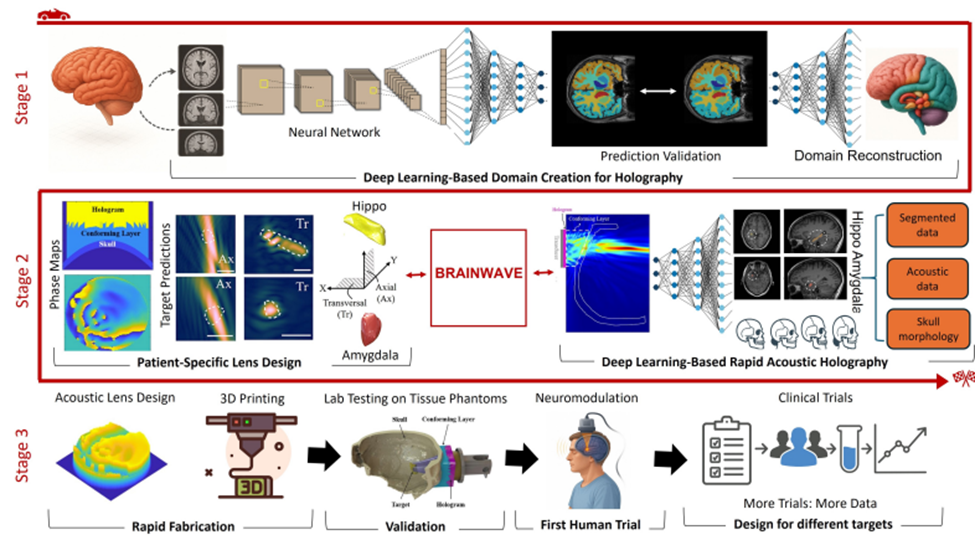
Figure: Workflow of the BRAINWAVE system for individualized, low-cost ultrasound neuromodulation using acoustic holography.
Advantages:
- Sub-millimeter precise neural targeting with skull distortion correction
- Lower cost and simpler hardware using static holographic lenses
- Fast patient-specific design using MRI or CT and machine learning
- Portable, noninvasive alternative to deep brain stimulation
Potential Application:
- Wearable at-home neuromodulation devices for noninvasive therapy
- Clinical treatment of neurological and psychiatric disorders such as depression and chronic pain
- Neuroscience research tools for deep brain mapping and cognitive studies
- Personalized manufacturing of skull-conformal acoustic lenses for healthcare providers