THE CHALLENGE
Polyvinyl chloride PVC creates a major business and sustainability challenge because its high chlorine content and complex additive mixtures make cost effective recycling difficult at industrial scale. Mechanical recycling often produces low value materials, while chemical and thermal methods generate chlorinated intermediates that require expensive dehalogenation, corrosion resistant equipment, and high energy input, reducing overall profitability. Disposal through incineration or landfill also brings regulatory and environmental liabilities. In addition, converting PVC derived streams into high value products such as polyalphaolefin lubricants typically relies on costly catalysts and tightly controlled processes, creating significant capital and operating barriers. These combined technical and economic constraints limit carbon circularity and leave substantial value in PVC waste unrealized.
OUR SOLUTION
We offer a direct conversion of polyvinyl chloride (PVC) waste into high-value, chlorine-free polyalphaolefin (PAO) lubricants through a single-step catalytic process. Utilizing aluminum chloride (AlCl₃) as a Lewis acid catalyst at a mild temperature of 70°C, the process simultaneously achieves dechlorination, alkylation, and chain scission of PVC in the presence of α-olefins and a suitable organic solvent. The method is effective for both pure and post-consumer PVC waste, and it avoids the need for expensive metallocene catalysts, producing lubricants with a linear backbone and desirable thermal and rheological properties. It addresses the longstanding challenge of PVC recycling by transforming a problematic, chlorine-rich plastic into a valuable, environmentally compliant lubricant base stock. The process is flexible, supporting both batch and continuous operation, and is validated by rigorous analytical techniques to ensure product quality. Its unique combination of waste valorization, cost-effectiveness, and the production of high-performance lubricants positions it as a transformative solution for advancing carbon circularity and the circular economy in the plastics and lubricants industries.
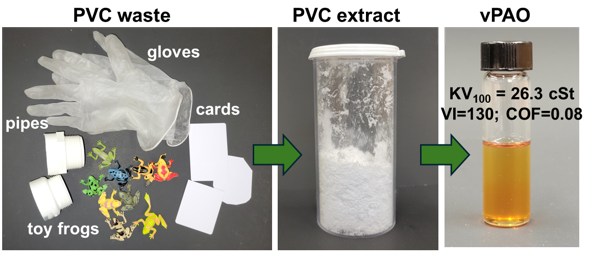
Figure: Photographs of PVC waste, extracted PVC powder, and the upcycled lubricant.
Advantages:
- Converts PVC waste into high-value, chlorine-free PAO lubricants
- Single-step, mild-temperature process without costly catalysts
- Tunable lubricant properties with industrial scalability
- Uses real-world PVC waste, enhancing sustainability
Potential Application:
- Manufacturing of PAO lubricant base stocks
- Production of industrial and automotive lubricants
- Integration into recycling and upcycling facilities
- Formulation of specialty and eco-friendly lubricants