THE CHALLENGE
A major business challenge facing the battery materials industry is the widening gap between rapidly increasing demand for lithium iron phosphate cathodes and the ability of existing supply chains to deliver consistent, high-purity iron and phosphate inputs at stable costs. Manufacturers remain heavily dependent on virgin mineral feedstocks and energy-intensive chemical processing, exposing them to price volatility, supply risk, and tightening environmental regulations. At the same time, mining and agricultural sectors incur substantial costs to manage waste streams such as acid mine drainage, pyrite tailings, and phosphorus-rich effluents that already contain these critical elements. The commercial reuse of these materials is constrained by complex chemistries, including impurity co-precipitation, poor selectivity in iron recovery, and challenges in sulfur removal, which prevent meeting battery-grade specifications at scale. This misalignment results in both lost economic value and ongoing environmental liabilities, highlighting the need for a business-ready solution that can transform waste management from a cost center into a reliable, compliant source of high-value battery precursors.
OUR SOLUTION
We offer a commercially scalable way to convert costly industrial and agricultural waste streams into high value, battery grade materials that are essential for lithium iron phosphate batteries. Instead of relying on volatile virgin mineral supply chains, the technology uses selective chemical processes to recover ferric phosphate and ferrous oxalate from acid mine drainage, pyrite, and phosphorus rich effluents while meeting strict purity and tap density requirements demanded by battery manufacturers. This approach transforms environmental liabilities that normally require expensive treatment into multiple revenue generating products, including battery precursors as well as recovered rare earth elements and aluminum oxide. The process is designed to minimize chemical inputs, reduce energy consumption, and integrate with existing mining and remediation infrastructure, which lowers operating costs and accelerates deployment. By combining waste remediation with secure local production of critical battery materials, the solution strengthens supply chain resilience, improves sustainability metrics, and creates a clear economic incentive for adoption across the battery, mining, and environmental services industries.
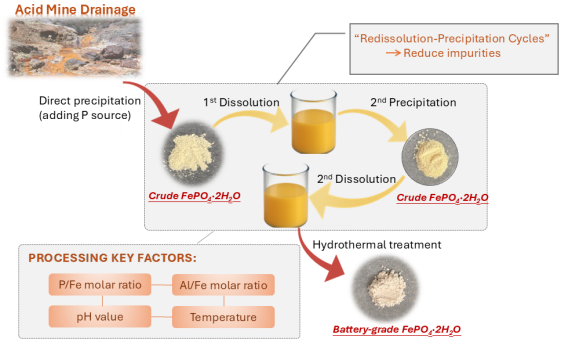
Figure: Overview of the invention.
Advantages:
- Converts waste streams into battery grade ferrous oxalate and ferric phosphate
- Reduces production costs and dependence on virgin mineral feedstocks
- Delivers high purity, high tap density materials suitable for LFP batteries
- Enables circular economy value through environmental remediation and byproduct recovery
Potential Application:
- LiFePO₄ cathode material manufacturing for batteries
- Battery-grade ferrous oxalate and ferric phosphate supply
- Rare earth element and aluminum oxide recovery from waste
- Environmental remediation of acid mine drainage and industrial effluents