THE CHALLENGE
Healthcare providers and medical device companies face a major commercialization barrier in deploying continuous biochemical monitoring tools for chronic wound care and other in vivo applications because current sensing technologies fail to operate reliably in real world biological environments. In protein rich biofluids, sensors such as surface enhanced Raman spectroscopy platforms rapidly degrade due to biofouling, where a protein corona forms on the sensor surface, blocking analyte access and causing signal drift, loss of sensitivity, and shortened device lifespan. This leads to frequent sensor replacement, higher costs, and poor clinical usability, making it difficult to deliver scalable, user friendly, and cost-effective solutions for long term patient monitoring. Existing cleaning and regeneration approaches rely on invasive procedures, external fluidics, or harsh chemical treatments that are impractical for wearable or implantable systems, creating a significant gap between promising laboratory performance and real-world deployment, and ultimately limiting market adoption and return on investment for next generation diagnostic technologies.
OUR SOLUTION
Our technology offers a breakthrough in continuous biochemical monitoring by providing a flexible, biocompatible sensing platform that maintains long term accuracy in complex biological environments, a critical need for chronic wound care and in vivo diagnostics. The platform integrates a macroporous polymer scaffold with nanolaminated nanoantenna arrays that enable highly sensitive molecular detection while also supporting a wireless, in situ regeneration mechanism. This active cleaning uses pulsed laser induced vapor nanobubbles to mechanically remove protein buildup from the sensor surface without harming surrounding tissue, overcoming a major limitation of conventional implantable sensors. By ensuring reliable, time resolved molecular profiling, this approach reduces device replacement costs, enhances usability, and opens the door for scalable, wearable, or implantable diagnostic solutions that can deliver real time data for proactive patient care and improved clinical outcomes.
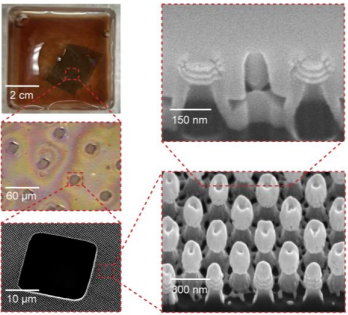
Figure: Images of the Multiresonant plasmonic nanoprotruding meshes (MPNM) at multiple scales.
Advantages:
- Continuous, long-term, and accurate biochemical monitoring in complex biofluids
- Wireless, non-invasive in situ sensor regeneration
- Ultra-sensitive, label-free molecular detection via SERS
- Biocompatible, flexible design with extended sensor lifespan
Potential Application:
- Advanced chronic wound care diagnostics
- Continuous blood glucose and metabolic monitoring
- Wearable sports performance and health tracking
- Implantable cancer biomarker monitoring